













A modern business website now has to do four jobs at once: look exceptional, convert visitors into qualified leads, perform in traditional search and communicate clearly enough to be understood in AI-powered search experiences. Trying to retrofit all four into an aging WordPress build can take longer, cost more and produce a weaker result than replacing the underlying system.
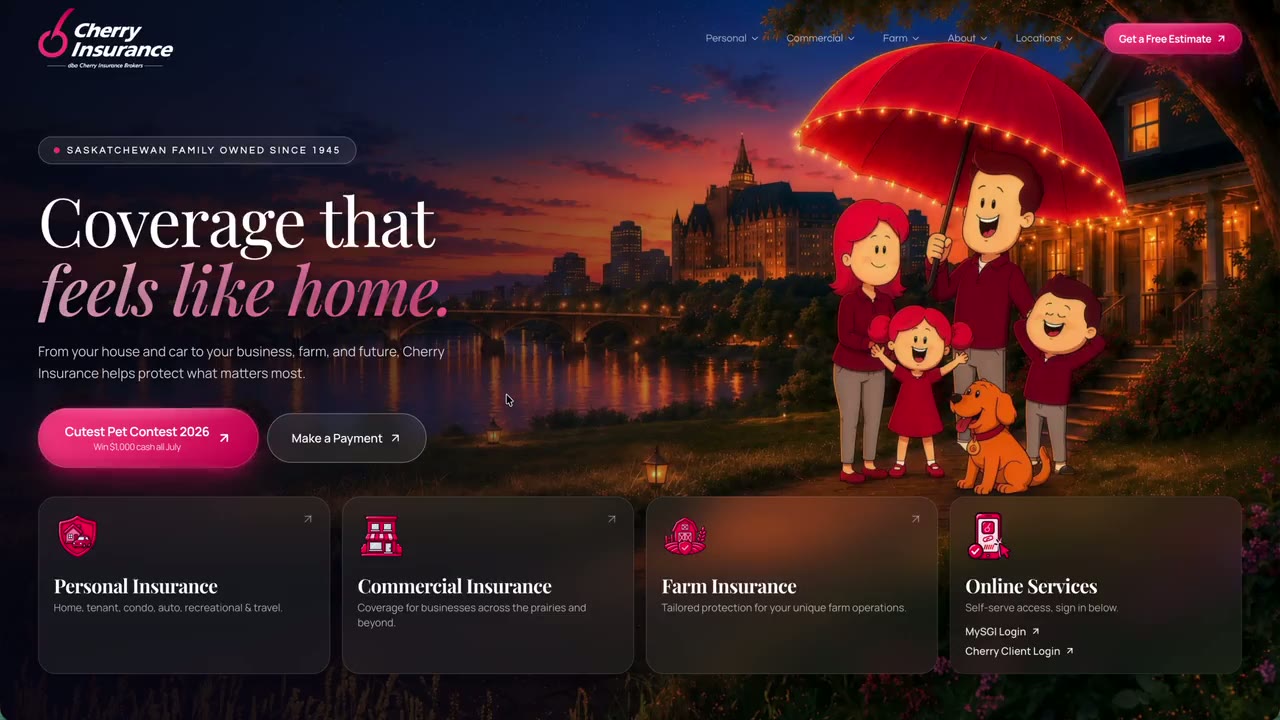
I recently rebuilt major websites for Cherry Insurance and Hoare Claxton in approximately two weeks each. In my previous WordPress workflow, websites with comparable ambition could have consumed many months of extensive work. The new sites are faster, easier to edit, easier to publish on and built around modern search from the beginning. Both clients were blown away by the difference.
If your current website still represents your business well and produces qualified leads, keep it. If your company has outgrown it, waiting another two or three years gives faster-moving competitors time to take the visibility and credibility you should own.
The same pattern shows up outside Saskatoon. If you are weighing a replacement in the Queen City, our web design services for Regina businesses page covers what a modern build includes.
WordPress Is Not the Enemy. An Outdated Website Is.
I have worked in web design and marketing since 2006. WordPress played an enormous role in making professional publishing accessible, and a well-built, well-maintained WordPress website can still rank and perform.
The problem is not the WordPress logo in the footer. The problem is what tends to accumulate around an older WordPress website:
- A dated theme that no longer reflects the calibre of the business
- Multiple plugins added over several years
- Page builders layered on top of themes layered on top of custom code
- Updates that create compatibility problems elsewhere
- Slow mobile layouts and oversized assets
- Content written for yesterday's search behaviour
- Forms and conversion paths that were never strategically designed
- A backend employees avoid because publishing feels risky or frustrating
Eventually, the business is not maintaining one clean website. It is maintaining a collection of dependencies that happen to produce a website. At that point, another redesign inside the same aging structure may be the wrong investment.
The Standard for a Business Website Has Changed
For years, the formula was relatively straightforward: create an attractive website, include the right keywords, make it mobile-friendly and update it every few years. That is no longer enough. Your website now needs to balance four competing demands.
1. It must look better than your competitors
Prospects judge the quality of your company before they speak with anyone. If your business is sophisticated but your website looks generic or five years behind, the website lowers the perceived value of everything you sell.
This is especially important for established B2B companies. A serious law firm, insurance brokerage, manufacturer, construction company or professional practice should not look smaller online than it is in real life.
2. It must convert attention into action
Traffic means very little if visitors cannot quickly understand:
- What you do
- Who you help
- Why they should trust you
- What makes you different
- What they should do next
Conversion is not a button colour. It is the combined effect of positioning, proof, page structure, writing, design and timing.
3. It must perform in traditional Google search
The fundamentals still matter: crawlable pages, clear site architecture, useful original content, strong internal linking, relevant titles, mobile performance and technical cleanliness.
Google's own guidance says that foundational SEO remains relevant to its generative AI features. There is no magic AI-search switch that replaces good SEO.
4. It must be understandable in AI-powered search
People are increasingly asking longer, more specific questions through Google AI Overviews, AI Mode, ChatGPT, Gemini and other answer engines. That changes how content should be planned. A modern site needs clear explanations, consistent business information, visible expertise, well-organized service content and direct answers to the questions prospects actually ask.
The objective is not to trick an AI system. It is to make your expertise unmistakably clear to people, crawlers and answer engines. Balancing design, conversion, SEO and AI-search visibility is difficult on any platform. It becomes much harder when the project begins with years of technical debt.
Why Aging WordPress Websites Become Expensive to Maintain
WordPress is open-source software supported by a large ecosystem of themes and plugins. That flexibility is its greatest strength and one of its biggest maintenance challenges.
Every additional component can introduce another update schedule, compatibility relationship and potential security concern. WordPress core, themes and plugins all need to remain current. An update can solve an important problem while exposing a conflict somewhere else in the stack.
This does not mean every WordPress update breaks a website. It means the owner of a self-hosted WordPress website is responsible for an ongoing maintenance system that many businesses never intentionally chose.
Security deserves the same nuance. WordPress itself is not inherently unsafe. But its popularity and enormous third-party ecosystem make outdated installations and vulnerable plugins attractive targets. The practical response is regular updates, backups, monitoring, limited plugin use and competent maintenance.
For some organizations, that responsibility is acceptable. For others, maintaining the machinery has become a distraction from what the website is supposed to accomplish.
The Hidden Cost Is Not Hosting. It Is Lost Momentum.
Businesses often evaluate an old website by asking, "Is it still online?" That is the wrong standard. A website can remain online while quietly costing the company:
- Prospects who choose a more credible competitor
- Qualified inquiries lost through weak mobile conversion
- Search visibility lost because important services lack useful pages
- Staff time wasted fighting the editor
- Developer costs for routine changes
- Campaign opportunities delayed because landing pages take too long
- Publishing momentum lost because every update feels difficult
- AI-search visibility lost because the business's expertise is poorly explained
The largest cost rarely appears as a line item. It appears as business that never arrives.
What Changed With Cherry Insurance and Hoare Claxton
The strongest evidence for me was not theoretical. It was what became possible in actual client work.
Cherry Insurance and Hoare Claxton both needed websites that balanced premium design, conversion, technical SEO, content depth and AI-search readiness. Using my older WordPress production process, websites with that level of ambition could have taken many months of extensive work. I rebuilt each website in approximately two weeks using an AI-native production process. See the Cherry Insurance campaign case study for an example of what that work produces.
FEATURED WORDPRESS REPLACEMENT
Cherry Insurance, Saskatoon
FEATURED WORDPRESS REPLACEMENT
Hoare Claxton, Calgary criminal defence

That does not mean an AI pressed a button and created the finished product. AI accelerated the research, architecture, writing, design iteration and code production. Twenty years of experience still determined what was credible, what would convert, what should rank and what was good enough to publish.
The result was not merely a faster version of the old process. The new websites:
- Load extremely quickly
- Present the businesses at a much higher visual standard
- Make editing and publishing easier
- Support blogging without wrestling with a fragile page builder
- Use clean, intentional page structures
- Build search considerations into the architecture
- Explain services in a form people and search systems can understand
- Can evolve much faster as the businesses change
The clients were blown away by the speed and quality of the work. That reaction matters because the website finally felt proportional to the business behind it.
Does Moving Away From WordPress Guarantee Better SEO?
No. Anyone telling you that changing platforms automatically improves rankings is selling nonsense.
Google does not rank a website simply because it uses WordPress, React or another framework. Search performance comes from the quality and usefulness of the content, technical accessibility, authority, user experience and how clearly the site satisfies search intent.
A terrible website can be built on modern technology. An excellent website can be built on WordPress.
The advantage of a modern rebuild is not a secret ranking boost. The advantage is the ability to create a cleaner, faster and more strategically complete website without carrying years of accumulated constraints into the new project.
What Should Replace an Aging WordPress Website?
Not every business needs the same technology. The replacement should be selected around the business, not around whatever platform an agency prefers selling. For an established B2B company, the new website should provide:
A clear conversion strategy
Every important page should have a purpose, a defined audience and a logical next action. The website should generate qualified conversations, not merely compliments.
Search architecture from the beginning
Services, industries, locations, proof and educational content should fit together intentionally. SEO should not be a plugin installed after the design is finished.
Content built from real expertise
Generic AI copy is not an advantage. Google explicitly recommends unique, valuable, people-first content. The best use of AI is to extract and organize genuine experience faster, then apply human judgment before anything is published.
Clear business and entity information
Your services, location, people, experience and proof should be consistent throughout the website and across the wider web. Relevant structured data can reinforce that information, but it cannot rescue weak or contradictory content.
Performance without constant repair
The website should load quickly on real mobile devices and remain manageable as content grows. Performance should be engineered into the system rather than recovered through an expanding collection of optimization plugins.
An editing experience people will actually use
If publishing a useful article or changing a service requires a developer every time, the website will fall behind again. A modern system should make routine content changes safe and straightforward.
What Happens If You Wait Two or Three More Years?
Your existing website will probably remain online. That is not the risk. The risk is that your competitors rebuild first.
While you continue working around an outdated system, a competitor can launch a faster website, explain its services more clearly, publish useful content more frequently and establish visibility across traditional and AI-powered search. Once that happens, you are no longer rebuilding to move ahead. You are rebuilding to recover ground.
For established companies, that delay can affect credibility, lead flow, rankings, AI-search visibility and overall competitive position. The cost compounds because search authority and market perception take time to build.
The transition does not need to happen because WordPress suddenly stopped working. It needs to happen when the website stops representing where the business is going.
Should Your Saskatoon Business Replace WordPress Now?
Consider rebuilding if several of those statements are no longer true. The decision should be based on opportunity cost, not fear. What could a faster, sharper and more visible website produce over the next three years compared with maintaining the current one? That is the calculation that matters.
The Bottom Line
WordPress helped build the modern web. But an aging WordPress website should not receive permanent immunity simply because it still loads.
In 2026, a serious business website must balance exceptional design, conversion, Google SEO and AI-search visibility. It must be fast to operate, easy to expand and strong enough to represent the business before a salesperson ever enters the conversation.
What once took me months of traditional production can now be accomplished in weeks with the right AI-native process and twenty years of judgment behind it. That changes what established Saskatoon businesses should expect from a website rebuild.
In the coming months, I will be helping a limited number of businesses make that transition. If your WordPress website no longer reflects the company you have built, message me. I will tell you honestly whether it needs to be replaced, improved or left alone.
Explore ATTRACT's Saskatoon web design work or book a strategy call to discuss the next version of your website.
Frequently Asked Questions
Is WordPress obsolete in 2026?
No. A properly engineered and maintained WordPress website can still perform well. The problem is that many business websites use aging themes, plugins and page builders that make modern design, performance, conversion and content development unnecessarily difficult.
Can a WordPress website appear in AI search results?
Yes. Platform alone does not determine AI-search visibility. Useful original content, crawlability, clear site structure, consistent business information and strong traditional SEO remain important. The challenge is whether an older WordPress build can support those requirements efficiently.
Does changing website platforms improve Google rankings?
Not automatically. A platform migration can improve performance and structure, but it can also damage rankings if URLs, redirects, content, metadata and internal links are mishandled. A proper rebuild must include an SEO migration plan.
How long does an AI-native website rebuild take?
ATTRACT has completed substantial business website rebuilds in approximately two weeks, although the timeline depends on scope, integrations, content and client feedback. More complex projects can take longer.
How much does a professional website rebuild cost in Saskatoon?
Professional website pricing depends on strategy, page count, content, integrations and ongoing search requirements. ATTRACT's custom business websites generally begin around $10,000, with larger corporate builds priced according to scope.